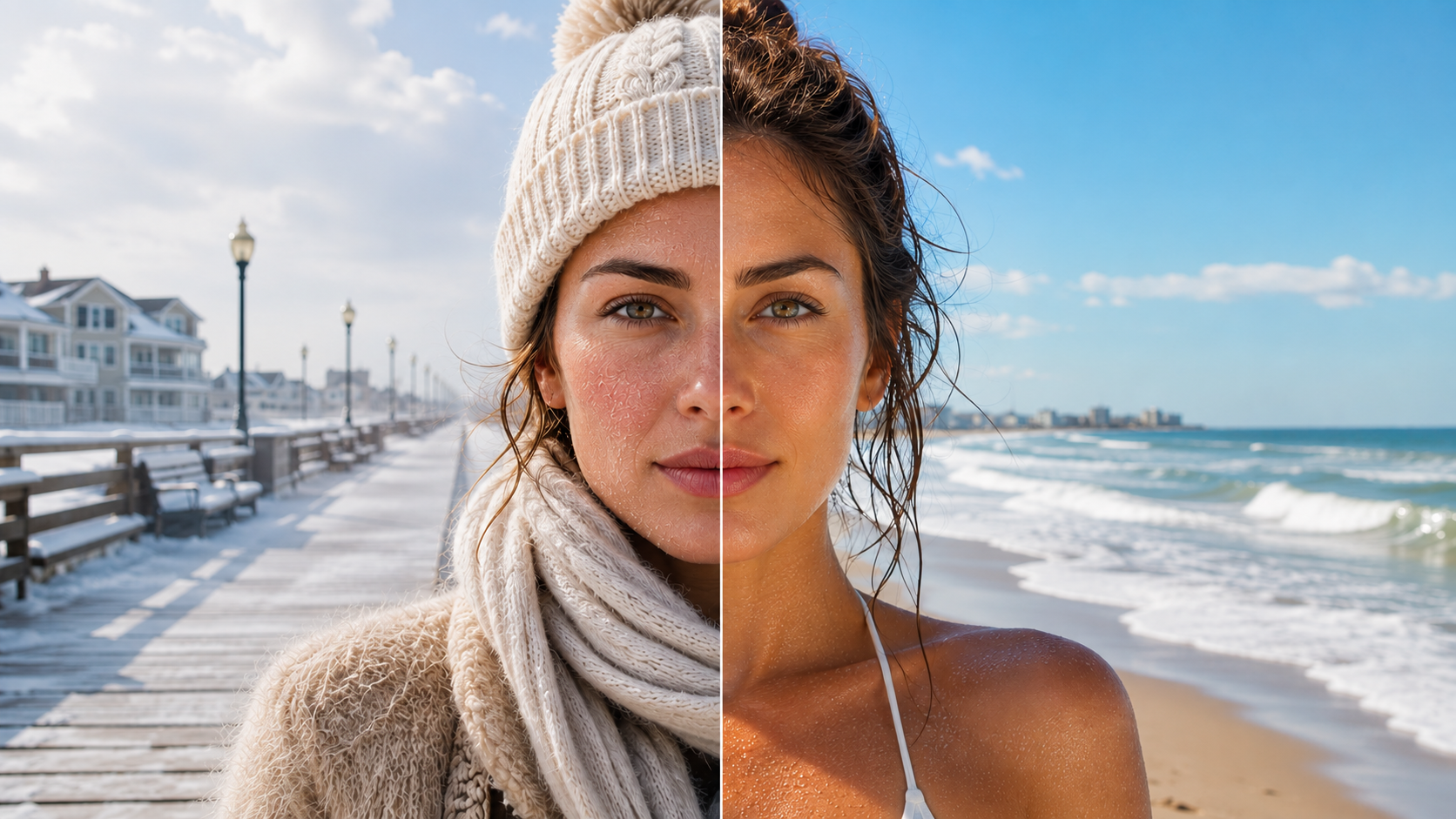
If your skin suddenly feels oilier, your pores seem more noticeable, or your favorite moisturizer feels like it just sits on top of your skin, you're not imagining it.
Summer humidity changes how your skin functions.
Here on Long Island, we're constantly moving between humid beach air, air-conditioned homes and offices, hot parking lots, and back into the AC again. Your skin is adapting to those changes all day long.
That's one reason the products that worked beautifully in February suddenly don't feel right in August.
Humidity Changes More Than Comfort
Your skin has one primary job: keep the good stuff in and the bad stuff out.
That protective barrier controls moisture loss, defends against irritants, and helps maintain healthy skin. Scientists often measure this by looking at transepidermal water loss (TEWL), essentially how much water escapes through your skin barrier.
Humidity directly influences that process.
When the air is dry, water leaves your skin more easily, which can leave it feeling tight, flaky, and sensitive. When the air is very humid, the opposite happens. Your skin retains moisture more easily, but sweat, oil, and environmental moisture also build up on the surface, creating an environment where congestion and breakouts become more common.
Neither is "good" or "bad." Your skin simply needs a different approach.
Summer Skin Isn't Always Oily, Sometimes It's Dehydrated
One of the biggest misconceptions we see is people assuming shiny skin means they need stronger cleansers. Often, the opposite is true.
Sweating more, washing your face more often, spending time in chlorine or salt water, and sitting in air conditioning can all leave your skin dehydrated, even while it looks oily.
That's why aggressive cleansing can backfire. Instead of restoring balance, it can further stress the skin barrier, leading to irritation and sometimes even more oil production as your skin tries to compensate.
Barrier Health Comes First
If you've been to Bodylogic, you've probably heard us talk about your skin barrier. That's because healthy skin starts there.
Whether we're performing a customized facial or simply recommending products for home, our goal is to support your skin, not overwhelm it.
For body treatments and massage, we also choose nourishing botanical oils that complement healthy skin rather than simply creating slip. Our Apricot Body Oil is lightweight and naturally rich in essential fatty acids, while Eminence Stone Crop Body Oil delivers hydration with soothing botanical ingredients that leave skin soft without feeling greasy. They're part of the reason clients often tell us their skin feels as good as it looks after a treatment.
Summer skin usually benefits from treatments that:
- remove congestion without over-exfoliating
- calm inflammation instead of chasing oil
- replenish hydration without feeling heavy
- strengthen the skin barrier so it functions the way it's supposed to
Sometimes that means dialing exfoliation back. Sometimes it means changing the products we use. Sometimes it means your skin simply needs more hydration than you think.
Healthy skin isn't about using more products. It's about using the right products for the environment your skin is living in. And in the middle of a humid Long Island summer, that's a very different environment than it was just a few months ago.
What Changes at Bodylogic During the Summer?
One thing we don't believe in is giving every client the same facial twelve months a year. In fact, we even create seasonal facial specials because the changing weather, and the way it affects your skin barrier, calls for a different approach. What your skin needs in the middle of a humid August isn't necessarily what it needs during the dry months of winter.
Every facial starts with what's happening today, not what your skin was doing three months ago.
If your skin has been feeling a little off lately, you don't need a whole new routine. You need one built for the season you're actually in. That's exactly what a customized facial at Bodylogic is for. Come see us, and we'll meet your skin right where it is today.
- DermNet: Skin Barrier Function
- American Academy of Dermatology: Dry Skin Overview
- PubMed: Engebretsen KA, et al. The effect of environmental humidity and temperature on skin barrier function and dermatitis
- PubMed: Goad N, Gawkrodger DJ. Ambient humidity and the skin: the impact of air humidity in healthy and diseased states